

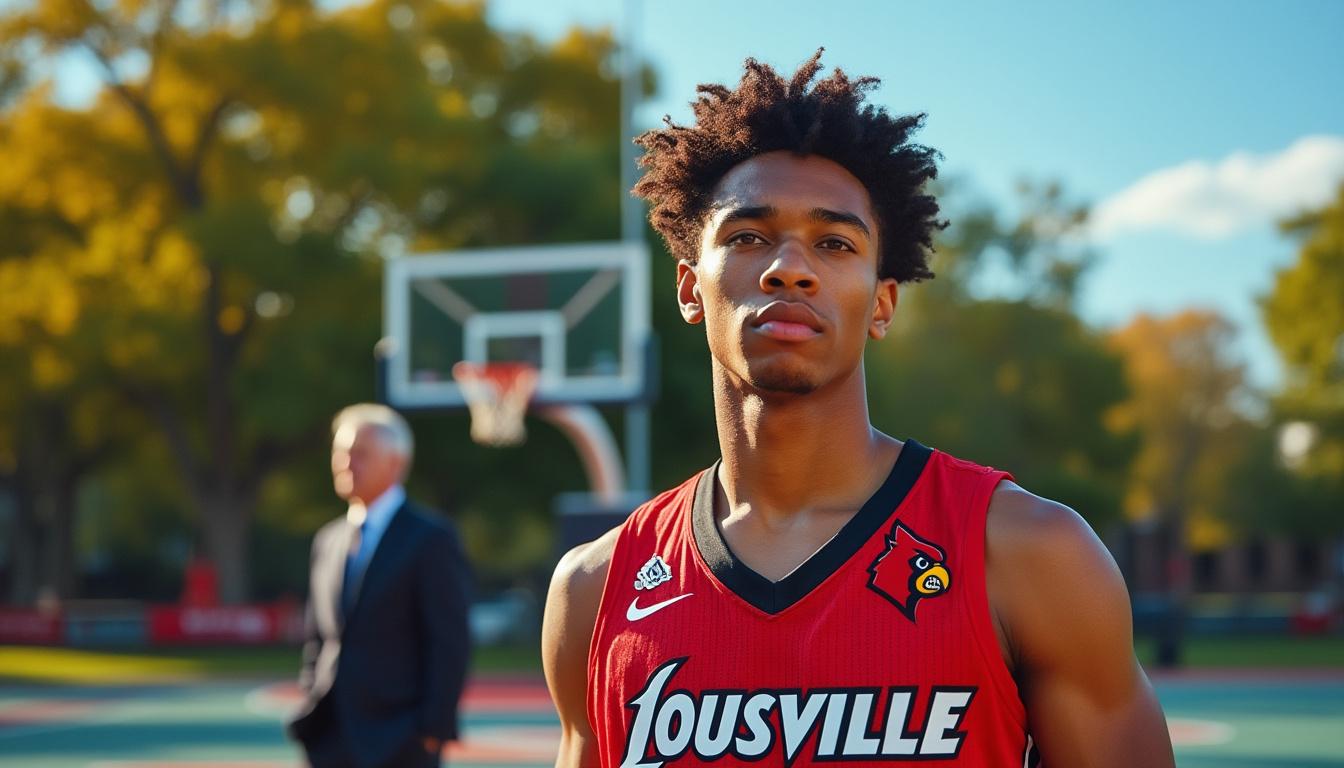
Karter Knox announced Wednesday that he will join Louisville basketball through the transfer portal, giving coach Pat Kelsey another high-profile addition for the coming season. The 6-foot-6 wing arrives after two years at Arkansas and becomes the program’s third portal pickup this offseason, following former Kansas big man Flory Bidunga and ex-Oregon guard Jackson Shelstad.
The move closes a recruitment that once leaned elsewhere. Knox had been a major target for Louisville under former coach Kenny Payne, but he originally chose Kentucky, then followed John Calipari to Arkansas after Calipari left Lexington for Fayetteville.
Karter Knox gives Louisville Basketball another major transfer portal win
Karter Knox committed after a reported visit to campus on Tuesday, and his decision adds another notable piece to one of the more aggressive offseason rebuilds in college basketball. Louisville has moved quickly, because roster turnover has been steep and the staff needed proven Division I production rather than a slower high school-only reset.
At the time of his pledge, only London Johnson and Adrian Wooley remained from the 2025-26 scholarship group. Readers tracking team changes should note that this level of churn is no longer unusual in NCAA transfers, especially when coaches rebuild around immediate contributors.
Knox was ranked by 247Sports as the No. 57 player to enter the portal this cycle. For a wing with size, high-major experience, and a workable outside shot, that standing helps explain why his basketball commitment drew attention beyond Louisville.
Louisville’s recent portal push also fits a broader national pattern. Programs now treat spring roster management almost like a second recruiting season, with player transfer decisions often reshaping preseason rankings faster than freshman signings do.
For readers following other frontcourt and international movement, this update on Vangelis Zougris and the transfer market offers another example of how fast roster building now moves in the modern game.
What Karter Knox produced at Arkansas and why Pat Kelsey wanted him
Knox’s sophomore season was uneven, but the underlying numbers still point to a useful rotation wing with room to grow. He averaged 8.1 points, 4.5 rebounds, and 1.2 assists in 22 minutes per game while shooting 46% from the field and 37.7% from 3-point range.
Across 58 games and 42 starts in two Division I seasons, he has posted 8.2 points per outing on 46.1% shooting, plus 3.8 rebounds and 1.1 assists. His turnover rate has been manageable, and that matters on a roster likely to put multiple new ballhandlers and scorers together at once.
| Category | 2025-26 at Arkansas | Career through transfer |
|---|---|---|
| Points per game | 8.1 | 8.2 |
| Field-goal percentage | 46.0% | 46.1% |
| 3-point percentage | 37.7% | 36.1% |
| Rebounds per game | 4.5 | 3.8 |
| Assists per game | 1.2 | 1.1 |
| Starts | Part of 2025-26 rotation | 42 in 58 games |
His best outing last season came in a Dec. 13 win over then-No. 16 Texas Tech. In that game, he scored 20 points on 8-for-11 shooting, hit three of four attempts from deep, and added six rebounds, two steals, two blocks, and one assist in 35 minutes.
That stat line shows why coaches stay patient with his profile. A 6-foot-6 wing who can defend spots on the perimeter, rebound his position, and make open threes remains a premium piece in basketball recruitment.
How injuries shaped his second season
Knox missed 15 games because of injuries and sat out the final 12 after a procedure to repair the meniscus in his left knee. That absence cut into his rhythm, and it also limited how much he could build on flashes from earlier in the season.
In practical terms, Louisville is betting on recovery and continuity. Meniscus procedures vary in long-term impact, but college programs routinely expect players to return to full competition after rehab, strength work, and summer conditioning.
That context matters when comparing portal options. A healthy wing with his measurables and shooting percentages would often cost more in roster value than his public ranking alone suggests.
How the Louisville roster is changing after three NCAA transfers
Pat Kelsey’s offseason now has three headline arrivals in a short span: Knox, Bidunga, and Shelstad. The mix is notable because it covers different lineup needs, with a ballhandler, a frontcourt presence, and a multi-positional wing entering the same roster cycle.
That kind of balance can stabilize a rebuild faster than stacking one position group. Readers comparing options should note that portal-heavy classes work best when roles fit together, not just when names look strong on paper.
- Karter Knox: 6-foot-6 wing with high-major experience and perimeter shooting.
- Flory Bidunga: former Kansas big man who adds size near the rim.
- Jackson Shelstad: former Oregon point guard expected to help organize the offense.
The larger story is not just talent acquisition. It is pace. Louisville moved from a thin returning core to a much more competitive structure in days, and that is why the program has climbed in early conversations about next season.
Knox also has a prior connection to the staff around Louisville’s broader recruiting history. Kenny Payne had made him a priority as a five-star member of the 2024 class, partly because Payne already knew the family through Kevin Knox Jr., Karter’s older brother, who played for Calipari and Payne at Kentucky before becoming a 2018 NBA lottery pick.
That background did not deliver him the first time, but it kept Louisville relevant. In player transfer recruiting, old relationships often matter even after a coaching change, because staff familiarity can shorten the trust-building process.
Anyone tracking how portal additions affect lineup construction can also compare this case with another recent transfer development here, where fit and timing shaped the market as much as talent did.
What happens next for Louisville and the college basketball transfer portal
The portal entry window closes at midnight on April 22, but that deadline only governs when players must enter, not when they must commit. Applicants in the college system often face hard dates that control eligibility windows, and this works in a similar way for rosters: entry closes first, decisions can continue afterward.
The regular signing period also opened Wednesday, which means roster movement and paperwork now run on parallel tracks. For schools, that creates a compressed planning period where coaches balance scholarship counts, medical evaluations, and late-market additions at once.
Louisville still has work to do, even after landing Knox. A few returners alone would not have been enough, so more team changes remain possible before the roster settles into a final shape.
One actionable takeaway for fans and analysts is straightforward: watch scholarship numbers and positional depth over the next two weeks, not just headline commitments. In modern college basketball, the most revealing offseason detail is often which role remains unfilled after the first portal wave ends.
For Knox, the immediate question is health and usage. For Louisville, the next checkpoint is whether this run of additions continues before the market fully settles.